
You don’t need a complete overhaul to transform your fitness. You need a starting point, a plan, and the willingness to keep showing up.
When we hear the word transformation, we often imagine dramatic before-and-after photos, grueling workouts, or hours spent in the gym. But some of the most meaningful transformations begin with something much simpler: 30 minutes of intentional movement.
Whether you’re beginning your fitness journey, returning after time away, or looking for a more efficient way to train, a well-designed 30-minute workout can help build strength, improve endurance, preserve muscle, and create lasting changes in how your body functions.
And here’s the exciting part: You don’t have to keep making your workouts longer to keep making progress.
You simply have to change how you challenge your body.
The secret is progressive overload.
Your body is remarkably adaptable. When you consistently challenge your muscles, they respond by becoming stronger and more capable. But as your body adapts, the same workout eventually becomes less challenging.
That’s where progressive overload comes in.
Progressive overload means gradually increasing the demands placed on your muscles. While adding weight is one way to accomplish this, it’s certainly not the only way.
You can also create a new challenge by changing:
- Tempo: Slowing down the lowering portion of an exercise to increase muscular control and time under tension.
- Repetitions: Gradually increasing the number of quality repetitions you perform.
- Resistance: Adding weight or choosing a stronger resistance band.
- Rest periods: Modestly reducing rest between exercises to challenge muscular endurance.
- Movement control: Adding pauses at the most challenging point of an exercise.
These techniques allow you to transform a familiar workout into a fresh challenge without constantly learning new exercises or spending more time training.
Why strength training matters during weight loss
As we explore GLP-1 medications and weight management in this month’s Living Fit, there’s an important conversation we need to have about muscle.
Weight loss and fat loss are not necessarily the same thing.
When we lose weight, some of that loss can come from lean tissue, including muscle. This is especially important for individuals experiencing significant weight loss, whether through lifestyle changes, medication, or a combination of both.
Resistance training helps provide the stimulus your body needs to preserve muscle. Combined with adequate protein, appropriate nutrition, and recovery, it can support strength and physical function throughout the weight-loss process.
And muscle matters for so much more than appearance.
It helps us climb stairs, carry groceries, maintain balance, support healthy aging, and remain independent as we get older.
The goal isn’t simply to become smaller. It’s to become stronger, healthier, and more capable.
That’s why this month’s workout focuses on building a foundation you can continue improving, one 30-minute session at a time.
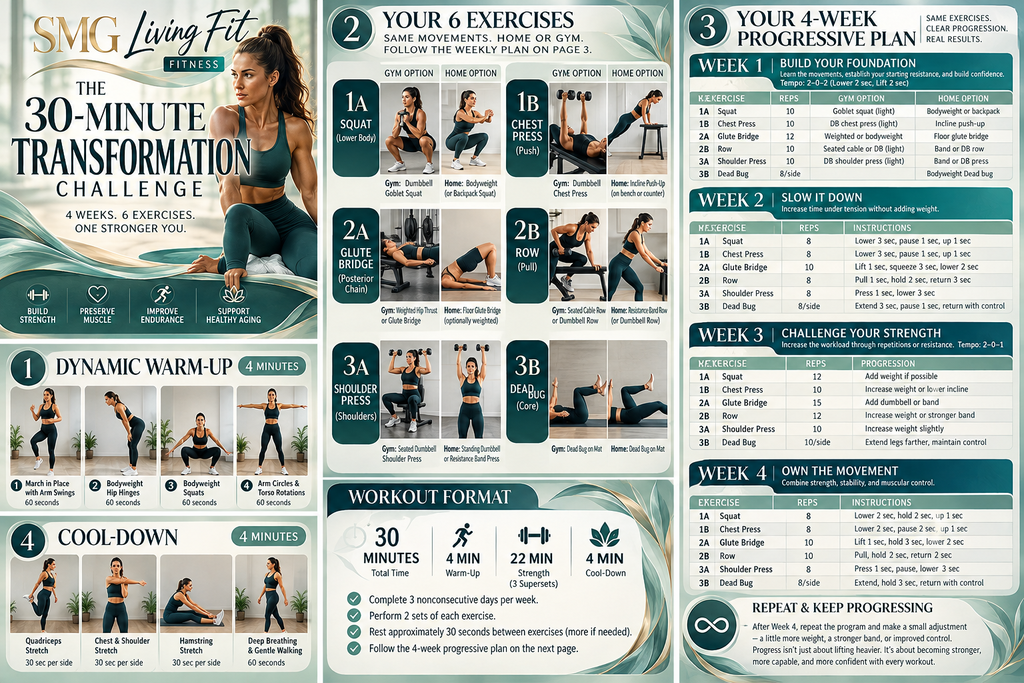
The 30-Minute Transformation Workout
TOTAL WORKOUT TIME
30 Minutes – Home + Gym
| 4 min | 22 min | 4 min |
| Warm up | strength | Cool down |
This full-body workout is designed to be performed three nonconsecutive days per week, giving your muscles time to recover between sessions.
You’ll use the same six fundamental movement patterns whether you’re training at home or in the gym. The exercises remain familiar, but the training techniques progress over four weeks.
Step 1: Four-Minute Dynamic Warm-Up
1. March in place with arm swings — 60 seconds
Gradually increase your heart rate while moving your arms naturally.
2. Bodyweight hip hinges — 60 seconds
Push your hips back with a neutral spine, then return to standing.
3. Bodyweight squats — 60 seconds
Move through a comfortable range of motion, focusing on control.
4. Arm circles and torso rotations — 60 seconds
Gently mobilize your shoulders and upper back.
Step 2: The 22-Minute Full-Body Workout
We’ll use three supersets. A superset pairs two exercises performed back-to-back, helping you train efficiently while working different muscle groups.
Perform each pair twice, alternating exercises, with approximately 30 seconds of rest after each pair. Allow about seven minutes per superset, including transitions. Use the remaining minute for setup.
Superset 1 — Lower Body & Push
1A. Squat
Gym: Dumbbell goblet squat
Home: Bodyweight squat or backpack squat
1B. Chest Press
Gym: Dumbbell chest press
Home: Incline push-up against a sturdy counter or bench
Superset 2 — Posterior Chain & Pull
2A. Glute Bridge
Gym: Weighted hip thrust or glute bridge
Home: Floor glute bridge, optionally weighted
2B. Row
Gym: Seated cable row
Home: Supported dumbbell or resistance-band row
Superset 3 — Shoulders & Core
3A. Shoulder Press
Gym: Seated dumbbell shoulder press
Home: Standing resistance-band or light dumbbell press
3B. Dead Bug
Gym: Dead bug on mat
Home: Dead bug on mat
Start with a resistance that allows you to finish every repetition with good form and approximately two or three repetitions left in reserve. For single-arm rows, complete both sides before moving on.
Step 3: Your Four-Week Transformation Plan
Same exercises. Same 30 minutes. A new challenge every week.
The beauty of this program is that you don’t need to learn an entirely new workout every week to see progress. Instead, we’ll gradually change how you perform each exercise by adjusting repetitions, tempo, resistance, and pauses.
Complete this workout three nonconsecutive days per week. Perform two sets of each exercise, using the supersets outlined above.
Step 4: Four-Minute Cool Down
Finish with gentle movement and breathing:
- Standing quadriceps stretch — 30 seconds per side
- Chest and shoulder stretch — 30 seconds per side
- Seated or standing hamstring stretch — 30 seconds per side
- Slow breathing and gentle walking — 60 seconds
“Before You Begin” Start with the gym or home version that feels most comfortable. Perform every exercise through a pain-free range of motion, and use a sturdy, stable surface for support when needed. If you’re new to resistance training, practice the movements without weights first. Rest longer when necessary; completing the workout safely matters more than finishing in exactly 30 minutes. If you’re using GLP-1 medication and experiencing nausea, dizziness, or difficulty eating and drinking adequately, adjust your workout and consult your healthcare professional.
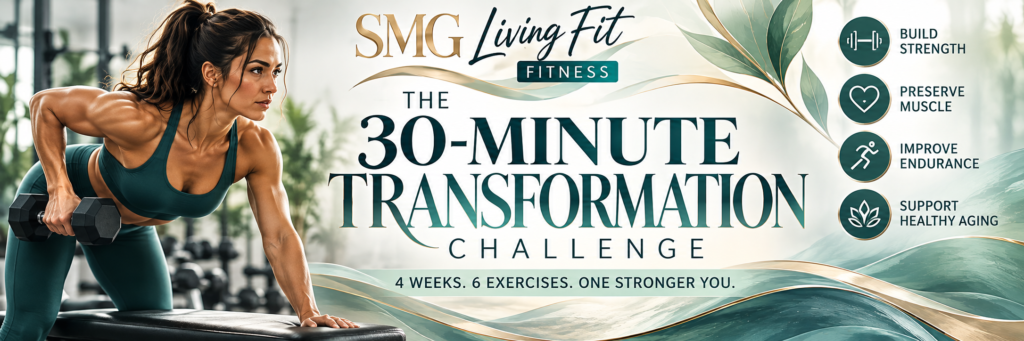
THE 30-MINUTE TRANSFORMATION CHALLENGE
4 Weeks. 6 Exercises. One Stronger YOU.
Week 1 — Build Your Foundation
Focus: Learn the movements, establish your starting resistance, and build confidence.
| Exercise | Your Week 1 Assignment |
| 1A. Squat | 10 repetitions, using bodyweight or a light dumbbell |
| 1B. Chest Press | 10 repetitions with light dumbbells or incline push-ups |
| 2A. Glute Bridge | 12 repetitions, bodyweight |
| 2B. Row | 10 repetitions with light resistance |
| 3A. Shoulder Press | 10 repetitions with light dumbbells or a band |
| 3B. Dead Bug | 8 repetitions per side, slow and controlled |
Training technique: Use a 2–0–2 tempo on the resistance exercises. Lower for two seconds and lift for two seconds. No pause is necessary.
Choose resistance that allows you to finish with approximately two or three good repetitions still possible.
Week 2 — Slow It Down
Focus: Increase time under tension without adding weight.
This week, you’ll use the same resistance as Week 1 when possible, but slow the movements down. You’ll discover that even light weights can feel challenging when you eliminate momentum.
| Exercise | Your Week 2 Assignment |
| 1A. Squat | 8 reps. Lower for 3 seconds, pause 1 second at the bottom, stand in 1 second |
| 1B. Chest Press | 8 reps. Lower for 3 seconds, pause 1 second, press up in 1 second |
| 2A. Glute Bridge | 10 reps. Lift in 1 second, squeeze your glutes for 3 seconds, lower in 2 seconds |
| 2B. Row | 8 reps. Pull in 1 second, squeeze shoulder blades for 2 seconds, return in 3 seconds |
| 3A. Shoulder Press | 8 reps. Press overhead in 1 second, lower slowly for 3 seconds |
| 3B. Dead Bug | 8 reps per side. Extend slowly for 3 seconds, pause for 1 second, return with control |
Training technique: Slow eccentrics and isometric holds. An eccentric is the lowering or lengthening portion of a movement. An isometric hold is when you pause and maintain muscular tension without moving.
Coach’s tip: If the slower tempo makes an exercise too difficult, reduce the resistance or shorten the range of motion slightly. Quality always comes first.
Week 3 — Challenge Your Strength
Focus: Increase the workload through repetitions or resistance.
Now that you’ve developed better movement control, it’s time to ask your muscles to do a little more work.
| Exercise | Your Week 3 Assignment |
| 1A. Squat | 12 reps. Add a light dumbbell or loaded backpack if Week 2 felt comfortable |
| 1B. Chest Press | 10 reps. Increase dumbbell weight slightly, or lower your incline push-up surface |
| 2A. Glute Bridge | 15 reps. Add a light dumbbell across your hips or a resistance band above your knees |
| 2B. Row | 12 reps. Increase the dumbbell weight or use a slightly stronger band |
| 3A. Shoulder Press | 10 reps. Increase weight slightly if you can maintain good form |
| 3B. Dead Bug | 10 reps per side. Extend your legs farther while keeping your lower back stable |
Training technique: Use a controlled 2–0–1 tempo for the resistance exercises: two seconds lowering and one second lifting. For the glute bridge, lift in one second and lower in two seconds.
The goal is to increase the challenge, not simply move faster or lift heavier.
Coach’s tip: Only increase resistance if you completed Week 2 with good technique and no joint discomfort. If you’re not ready for heavier weights, use the Week 3 repetition target with your current resistance.
Week 4 — Own the Movement
Focus: Combine strength, stability, and muscular control.
This is where you’ll discover how much you’ve improved. Instead of simply adding more weight, we’re going to challenge your muscles with strategic pauses and controlled movement.
| Exercise | Your Week 4 Assignment |
| 1A. Squat | 8 reps. Lower for 2 seconds, hold at the bottom for 2 seconds, stand in 1 second |
| 1B. Chest Press | 8 reps. Lower for 2 seconds, pause just above chest level for 2 seconds, press up in 1 second |
| 2A. Glute Bridge | 10 reps. Lift, hold the top position for 3 seconds, lower slowly for 2 seconds |
| 2B. Row | 10 reps. Pull toward your torso, hold the contraction for 2 seconds, return slowly for 2 seconds |
| 3A. Shoulder Press | 8 reps. Press overhead in 1 second, pause briefly, lower for 3 seconds |
| 3B. Dead Bug | 8 reps per side. Extend slowly, hold for 3 seconds, return without allowing your back to arch |
Training technique: Isometric pauses and controlled repetitions.
For Week 4, use the resistance from Week 3 only if you can complete every repetition without sacrificing technique. Otherwise, return to a lighter resistance.
Coach’s tip: The pauses should be challenging, but you should still be able to breathe normally. Never hold your breath during an exercise.
Your Four-Week Transformation at a Glance
| 01 | 02 | 03 | 04 |
| Foundation | Tempo | Progress | Mastery |
| Learn | Control | Challenge | Own It |
| All four weeks: 3 nonconsecutive training days • 2 sets per exercise • Approximately 30 seconds rest between supersets, with additional rest as needed. | |||
What happens after Week 4?
Now you have a foundation you can continue building on!
Repeat the program, beginning again with Week 1, but make one small adjustment based on your progress. You might use a slightly heavier dumbbell, a stronger resistance band, or a more challenging push-up angle.
For example, if you started with a 5-pound dumbbell for shoulder presses and can now comfortably complete all your repetitions, you might begin the next four-week cycle with a 7-pound dumbbell. If that’s too large an increase, stay with 5 pounds and focus on better control.
Keep a simple record of your weights, repetitions, and how each exercise feels. Progress isn’t always measured in pounds lifted. Better balance, improved coordination, and greater confidence are all signs of transformation.
Remember: The goal isn’t to complete four perfect weeks. The goal is to become a little stronger, more confident, and more capable with every workout.
The workout should remain challenging, but it should never feel punishing. If you’re new to exercise, managing a medical condition, or experiencing fatigue or dizziness while using weight-management medication, modify the intensity and seek appropriate medical guidance.
Transformation is built through consistency
One of the biggest misconceptions about fitness is that results require extreme effort.
In reality, meaningful change is often the result of small, intentional actions repeated over time.
Thirty minutes may not seem like much, but three sessions each week add up to six hours of focused strength training over four weeks. More importantly, they help establish a habit that can continue for months and years.
As we explore the changing landscape of weight management, including GLP-1 medications, remember that lasting health is about more than losing pounds. It’s about protecting muscle, maintaining strength, supporting mobility, and investing in your future.
You don’t need to transform everything overnight.
Start with 30 minutes. Build on your progress. Trust the process.
Because the most powerful transformation isn’t just the one you see in the mirror. It’s the one you feel in everything you’re able to do.

Follow us
@southernmuscleguide