

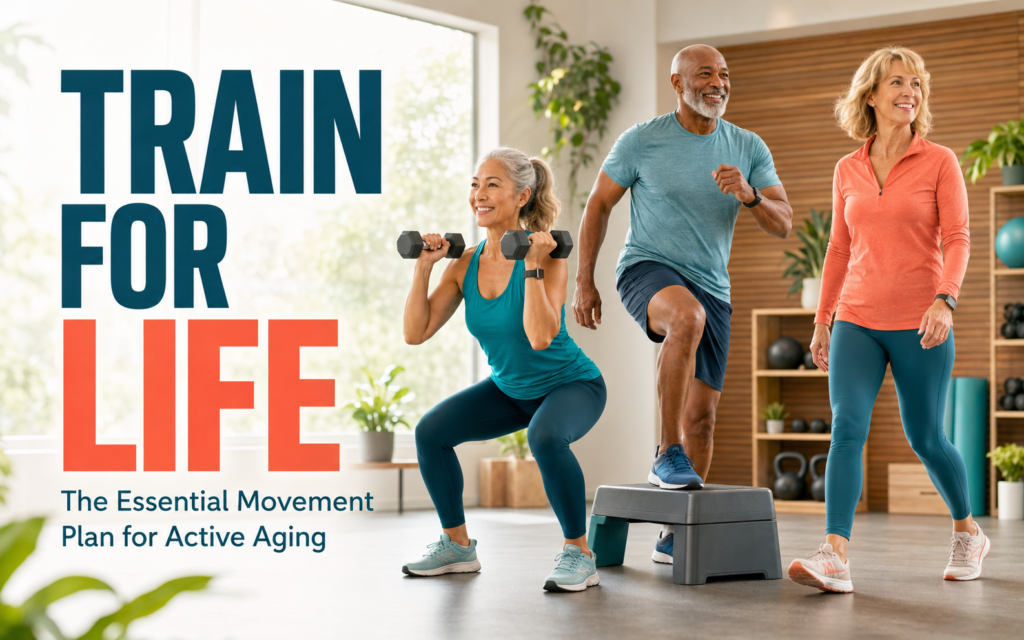
Active aging isn’t about trying to turn back the clock. It’s about building a body that allows you to keep moving forward—with strength, energy, confidence, and independence.
That is the heart of vitality.
Your lifespan measures how many years you live. Your healthspan reflects how many of those years you can spend feeling capable, active, and engaged in the life you love. While genetics and health conditions play a role, the way you move today can have a powerful influence on how well you continue to move tomorrow.
The goal isn’t simply to live longer. It’s to have the strength to carry your groceries, the balance to move confidently, the mobility to reach and bend comfortably, and the endurance to travel, play with your grandchildren, enjoy your hobbies, and continue showing up for the people who matter most.
Movement Is an Investment in Your Future
As we age, it is normal to experience changes in muscle mass, bone density, balance, mobility, and cardiovascular capacity. But getting older does not mean becoming powerless.
Consistent exercise can help preserve the physical abilities that support everyday life. A complete active-aging program should include more than one type of movement. It should train the body in several important ways:
- Strength to maintain muscle, support the joints, protect the bones, and make daily tasks easier
- Balance to improve stability, coordination, and confidence
- Mobility to help the body bend, reach, rotate, and move through comfortable ranges of motion
- Cardiovascular exercise to support heart health, endurance, energy, and recovery
- Recovery to give the body time to adapt, repair, and grow stronger
You don’t have to master everything at once. Small, consistent efforts add up—and movement can be adjusted to meet you where you are today.
Train for What You Want to Keep Doing
Exercise becomes even more meaningful when you connect it to real life.
A squat isn’t just a gym exercise; it helps you rise from a chair. A step-up prepares you to climb stairs. A row strengthens the muscles that support good posture. Carrying weights can make groceries, luggage, and household tasks easier. Balance training helps you feel steadier when walking on uneven surfaces, while mobility work makes it more comfortable to turn, reach, and bend.
This is functional fitness at its best: training with a purpose beyond the workout itself.
Every repetition is an opportunity to reinforce a message to your body:
I am preparing for the life I want to keep living.
The Vitality Workout
Strength, Balance and Mobility for Life
This full-body workout develops several of the abilities that support an active, independent lifestyle. Choose the version of each exercise that matches your current fitness level.
Complete 2–3 rounds, resting as needed between exercises. Beginners may start with one round and gradually progress.
Warm-Up
Perform each movement slowly and comfortably:
- Purposeful walk or march in place: 3–5 minutes
- Shoulder rolls: 10 forward and 10 backward
- Standing torso rotations: 10 per side
- Heel-to-toe rocks: 10 repetitions
- Sit-to-stand practice: 8 repetitions
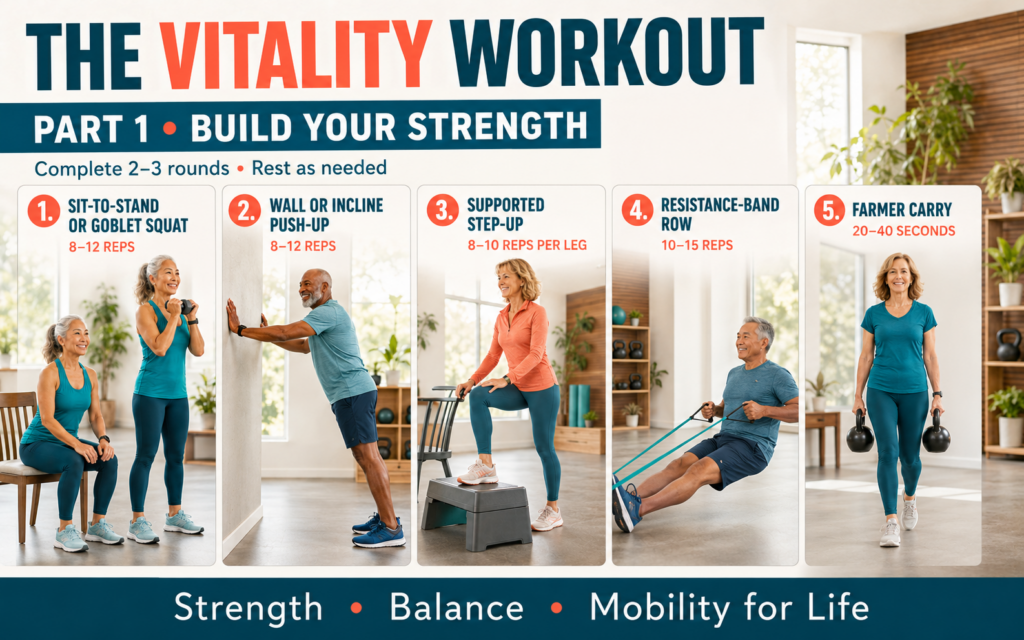
1. Sit-to-Stand or Goblet Squat
Perform: 8–12 repetitions
Sit back toward a sturdy chair, keeping your chest lifted and feet firmly planted. Lightly touch the chair—or sit briefly—then press through your feet to stand tall.
Make it easier: Use your hands or a higher chair for assistance.
Progress it: Hold a dumbbell close to your chest.
Life connection: Getting up from chairs, couches, beds, and other seated positions.
2. Wall or Incline Push-Up
Perform: 8–12 repetitions
Place your hands against a wall, countertop, or sturdy bench. Keep your body in a straight line as you bend your elbows and bring your chest toward the surface. Press away with control.
Make it easier: Use a wall and stand closer to it.
Progress it: Use a lower surface or perform a traditional push-up.
Life connection: Pushing open doors, moving objects, and supporting yourself as you rise.
3. Supported Step-Up
Perform: 8–10 repetitions per leg
Place one foot on a low, stable step. Push through that foot to rise, then lower yourself slowly. Use a railing or sturdy support when needed.
Make it easier: Use a very low step or practice alternating toe taps.
Progress it: Increase the step height or hold light weights.
Life connection: Climbing stairs, stepping onto curbs, and navigating changes in elevation.
4. Resistance-Band Row
Perform: 10–15 repetitions
Anchor a resistance band securely. Pull the handles toward your ribs while gently drawing your shoulder blades together. Slowly return to the starting position.
Make it easier: Use a lighter band.
Progress it: Increase the resistance or pause briefly at the end of each row.
Life connection: Supporting posture and strengthening the muscles used to pull and carry.
5. Farmer Carry
Perform: 20–40 seconds
Hold one weight in each hand, stand tall, and walk with steady, controlled steps. Keep your shoulders relaxed and your eyes forward.
Make it easier: Use lighter weights or march in place near a sturdy support.
Progress it: Increase the weight, distance, or time.
Life connection: Carrying groceries, luggage, laundry, and household items.
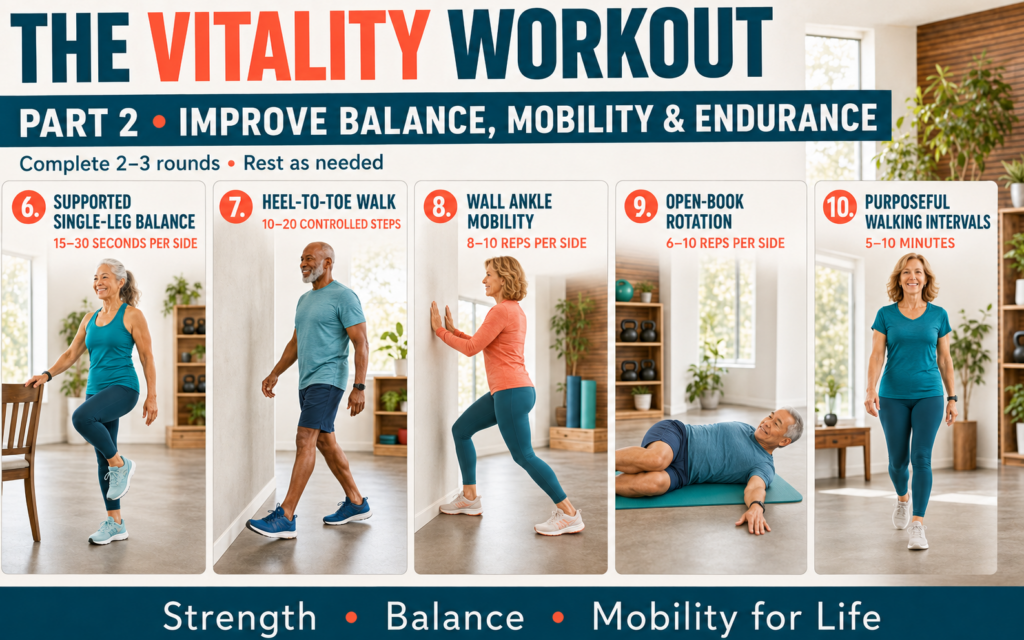
6. Supported Single-Leg Balance
Perform: 15–30 seconds per side
Stand beside a wall or sturdy chair. Shift your weight onto one leg and lift the opposite foot slightly from the floor. Maintain tall posture and use support when needed.
Make it easier: Keep the toes of the lifted foot lightly touching the floor.
Progress it: Use less hand support or add a slow knee drive.
Life connection: Walking, climbing stairs, getting dressed, and recovering from an unexpected misstep.
7. Heel-to-Toe Walk
Perform: 10–20 controlled steps
Walk in a straight line, placing the heel of one foot directly in front of the toes of the other. Keep your eyes forward and stay near a wall if you need support.
Make it easier: Leave a small space between your feet.
Progress it: Walk forward and backward with control.
Life connection: Improving coordination and confidence while moving through tight or uneven spaces.
8. Wall Ankle Mobility
Perform: 8–10 repetitions per side
Stand facing a wall with one foot forward. Keep your heel down as you gently guide your knee toward the wall, then return to the starting position.
Life connection: Walking comfortably, climbing stairs, squatting, and maintaining balance.
9. Open-Book Rotation
Perform: 6–10 repetitions per side
Lie on your side with your knees bent and arms extended in front of you. Slowly rotate your top arm and upper body away, following your hand with your eyes. Return with control.
If getting onto the floor is uncomfortable, perform a gentle seated rotation from a sturdy chair.
Life connection: Turning, reaching, getting in and out of a vehicle, and looking behind you.
10. Purposeful Walking Intervals
Perform: 5–10 minutes
Alternate:
- 1 minute at a comfortable pace
- 30 seconds at a slightly faster, purposeful pace
Repeat for the desired time.
Use a treadmill, indoor hallway, walking path, or march in place. The faster interval should feel challenging but controlled—you should still be able to speak in short sentences.
Life connection: Building the stamina to travel, shop, explore, socialize, and enjoy daily activities without tiring as quickly.
Finish with Recovery
Cool down with several minutes of easy walking and relaxed breathing. Add gentle stretches for the calves, chest, hips, and upper back, holding each stretch without bouncing or forcing the range of motion.
Consistency Creates Capacity
You do not have to exercise at the same level you did years ago—and you do not need to compare your body with anyone else’s.
Start with what you can do safely. Practice it consistently. Gradually add repetitions, resistance, time, or range of motion as your ability improves. Progress does not have to be dramatic to be meaningful.
Every workout is a deposit into your healthspan. Every walk, squat, carry, stretch, and balance exercise helps build the physical capacity to remain involved in your own life.
Vitality isn’t defined by your age. It is reflected in your willingness to keep moving, growing, and preparing for everything you still want to experience.
Move with purpose today so you can keep living with freedom tomorrow.
Consult your healthcare provider before beginning a new exercise program, particularly if you have a medical condition, injury, balance concerns, or recent changes in your health.

Follow us
@southernmuscleguide