

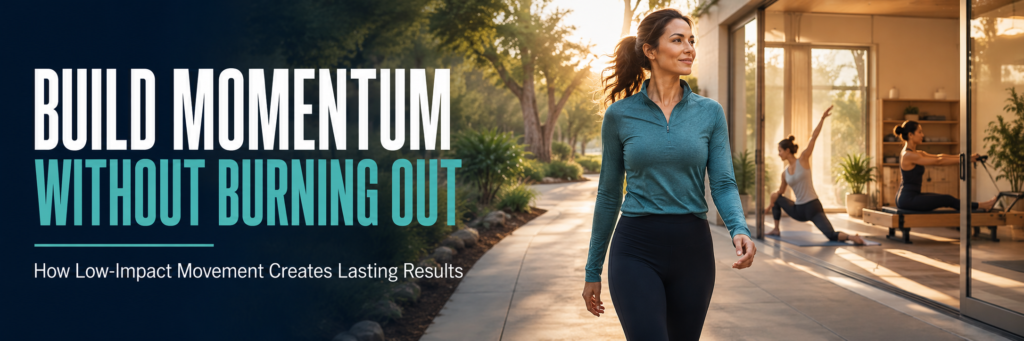
How Low-Impact Movement Creates Lasting Results
When most people think about making progress in fitness, they imagine doing more—training longer, lifting heavier, moving faster, or pushing harder. But lasting progress rarely comes from one exhausting workout. It comes from choosing movement you can return to consistently.
That is the power of momentum.
Momentum doesn’t require you to go from zero to one hundred overnight. It begins with one manageable decision: taking a short walk, completing a mobility routine, attending a Pilates class, or simply getting up and moving when it would be easier to remain still. One choice leads to another, and over time, those small efforts begin to create meaningful change.
Consistency Beats Intensity
An intense workout may leave you feeling accomplished, but if it also leaves you overly sore, discouraged, or unable to exercise again for several days, it may not help you build a sustainable routine.
Low-impact exercise offers another path. Walking, cycling, swimming, Pilates, mobility work, and certain forms of martial arts can challenge your muscles, improve coordination, and support your overall fitness without placing unnecessary stress on your joints.
“Low impact” does not mean “low effort” or “no results.” It simply describes movement that reduces the amount of force your body absorbs. You can still improve your strength, endurance, balance, and confidence while working at an intensity that meets you where you are.
The best workout isn’t necessarily the hardest one. It’s the one you can perform safely, enjoy, and continue doing.
Start with a Walk
Walking is one of the simplest ways to begin building momentum. It doesn’t require a complicated program, a gym membership, or advanced experience. You can walk through your neighborhood, around a track, on a treadmill, or through the aisles of a store when the weather doesn’t cooperate.
A walk can also become whatever you need it to be. It might be quiet time to pray, an opportunity to listen to music or a podcast, or a chance to connect with a friend. The increasingly popular “hot girl walk” may have a playful name, but its appeal is easy to understand: walking can support both physical movement and a healthier mindset.
Begin with a pace and duration that feel realistic. Ten consistent minutes are more valuable than an ambitious hour that you never repeat.
What About a Weighted Vest?
Once regular walking feels comfortable, some people may choose to add a weighted vest. The additional resistance can make an ordinary walk more challenging without requiring you to run.
However, more weight is not always better. A vest that is too heavy—or added before your body is ready—can affect your posture and place additional stress on your joints. Start light, keep your walking route manageable, and pay attention to how your body responds.
Anyone with joint, balance, heart, or bone-health concerns should speak with a qualified healthcare professional before adding a weighted vest or significantly changing an exercise routine.
Strength That Moves with You
Pilates has grown in popularity because it combines controlled movement, core strength, stability, posture, and body awareness. Although the exercises may appear gentle, moving slowly and with intention can be surprisingly challenging.
Mobility training provides another important piece of the puzzle. Mobility is not simply being flexible—it is having the strength and control to move your joints through a comfortable range of motion. A few minutes of intentional mobility work can help you feel less stiff and more prepared for workouts and daily activities.
Martial arts can also offer adaptable, low-impact options. Technique drills, controlled combinations, balance exercises, and beginner-friendly classes can build coordination and confidence while keeping movement interesting.
The goal is not to choose the activity everyone else is doing. It is to find movement that fits your body, your current season, and your life.
Progress Gradually
Momentum grows when we give ourselves somewhere to build from. If you begin by doing too much, too soon, your routine may become difficult to maintain.
Instead, change one variable at a time. You might add five minutes to a walk, attend one additional class, increase your resistance slightly, or include a short mobility session on a recovery day.
You will not feel equally motivated every day. That is why your routine needs options. On high-energy days, you may complete your entire workout. On difficult days, ten minutes of movement may be the victory.
Both count.
Your Seven-Day Momentum in Motion Plan
Use this simple plan as a starting point, adjusting the time and intensity to fit your needs.
Day 1 — Take the First Step
Complete a comfortable 10- to 20-minute walk.
Day 2 — Move with Control
Try 15 to 20 minutes of beginner Pilates or gentle core work.
Day 3 — Restore Your Movement
Complete a short mobility routine focusing on your hips, shoulders, and upper back.
Day 4 — Walk and Connect
Invite a friend to walk with you, or use the time for prayer and reflection.
Day 5 — Practice Something New
Try a beginner martial arts drill, low-impact cardio class, swim, or bike ride.
Day 6 — Build Your Strength
Complete a simple full-body resistance workout using light weights, bands, or your body weight.
Day 7 — Recover and Reflect
Take an easy walk or perform gentle stretching. Consider what felt good, what was challenging, and what you would like to continue.
Take the 10-Minute Momentum Challenge
For the next seven days, choose one low-impact activity and commit to doing it for at least 10 minutes each day.
Don’t worry about making every session impressive. The purpose of the challenge is to practice showing up. Ten minutes may lead to twenty—or ten minutes may be exactly what your body needs that day.
Momentum isn’t built by being perfect. It is built each time you choose to begin again.
Start where you are. Move in a way you enjoy. Then let one faithful step lead to the next.

Follow us
@southernmuscleguide